
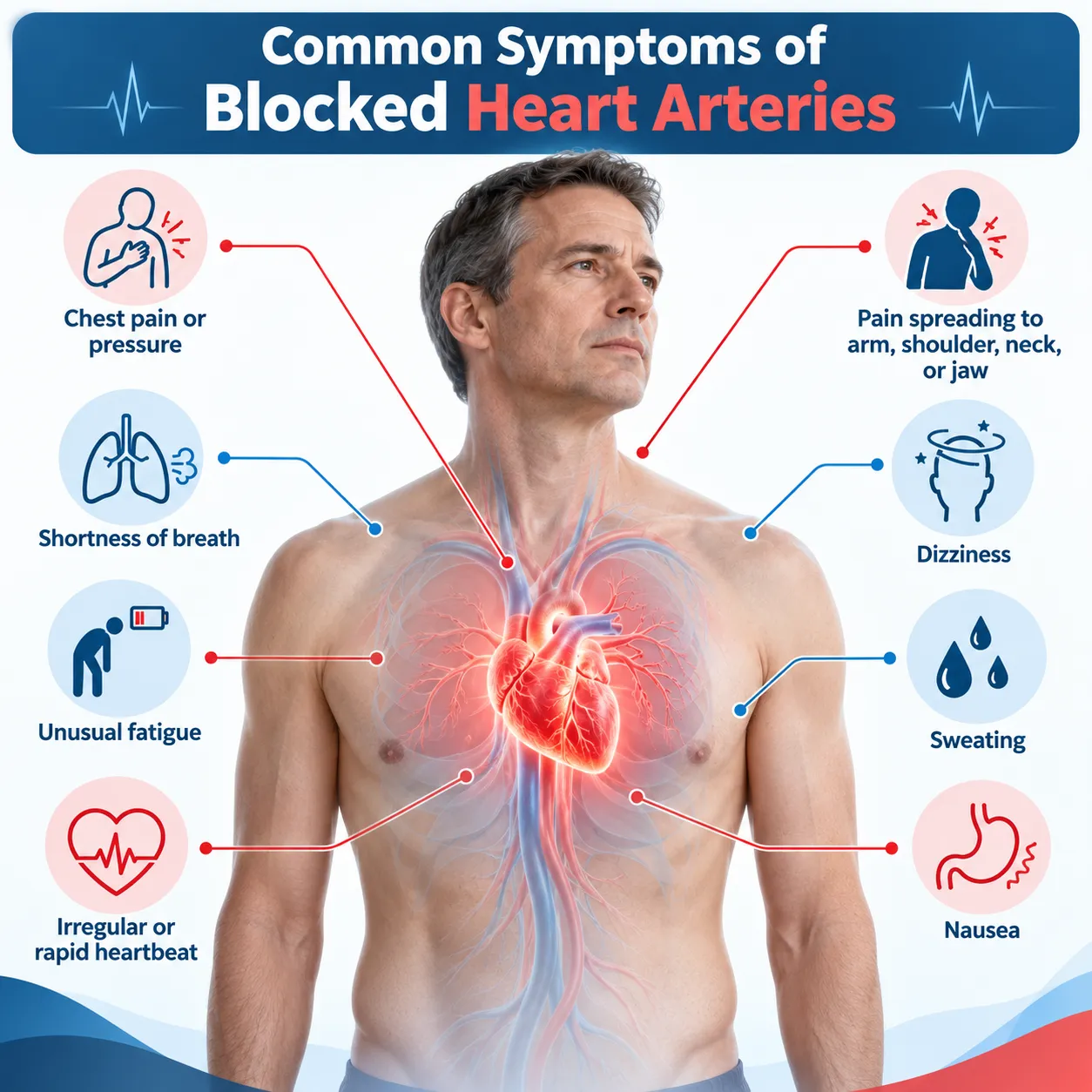
Blocked heart artery symptoms include chest pain or pressure, shortness of breath, unusual fatigue, pain that spreads to the arm, shoulder, neck, or jaw, dizziness or lightheadedness, sweating, nausea, and an irregular or rapid heartbeat. Some people experience heart artery blockage with no symptoms at all until it becomes severe, which is part of why coronary artery blockage symptoms are so often missed, dismissed, or mistaken for something unrelated to the heart.
According to Dr. Kiran Narang, an experienced interventional cardiologist in Mumbai, “Most patients I see with a significant blockage never had the textbook chest pain. It’s breathlessness on stairs they used to manage easily, or a heaviness that comes and goes and gets blamed on gas or stress. In diabetics especially, the artery can be quite blocked and the person feels almost nothing. That’s exactly why we don’t wait for a dramatic symptom before testing, an ECG and an echo tell us more in twenty minutes than months of guessing.”
What Does a Blocked Heart Artery Mean?
Common Symptoms of Blocked Heart Arteries
What Does Chest Pain From a Blocked Artery Feel Like?
Chest pain caused by a blocked artery, medically called angina, rarely feels like a sharp, localised stab. It’s usually described as pressure, tightness, squeezing, or a heavy weight sitting on the chest, and it tends to be triggered by exertion, walking briskly, climbing stairs, or physical exertion of any kind, and then ease again within a few minutes of rest. Some people feel it centred behind the breastbone, while others notice it spreading outward toward the shoulder, arm, or jaw. The discomfort can also be accompanied by breathlessness or a sense of tightness that makes a full breath feel harder to take. This pattern, discomfort with exertion that settles with rest, is one of the clearest clues that chest pain is coming from reduced blood flow to the heart rather than a muscular or digestive cause.
Can You Have a Blocked Heart Artery Without Symptoms?
Yes, and it’s more common than most people expect. Blockages under roughly 50% narrowing often don’t restrict blood flow enough to cause any noticeable symptoms, which means they’re sometimes only discovered incidentally during testing done for an unrelated reason. In people with long-standing diabetes, nerve damage can blunt the pain signals that would normally accompany reduced blood flow, a phenomenon known as silent ischemia, allowing a blockage to progress further than it otherwise would before anyone notices anything is wrong. This is one of the reasons routine cardiac screening matters for anyone with diabetes, uncontrolled hypertension, or a strong family history of heart disease, even when there are no symptoms to prompt a visit in the first place.
Symptoms of Heart Artery Blockage in Men and Women
Men more often present with the classic pattern, chest pain or pressure that’s fairly easy to link to the heart. Women, by contrast, are more likely to experience heart artery blockage with symptoms that don’t fit that textbook picture as clearly: fatigue, breathlessness, nausea, or discomfort in the back, neck, or jaw, sometimes with little or no chest pain at all. This difference is a significant reason heart disease tends to be recognised later in women, since both patients and doctors can be slower to connect these more atypical symptoms to the heart. Anyone with risk factors for coronary artery disease, regardless of how classic or unusual their symptoms feel, is better served by getting them evaluated than assuming they don’t fit the pattern.
How Are Blocked Heart Arteries Diagnosed?
Diagnosis usually starts with a clinical evaluation and works through a combination of the following tests, depending on what the initial assessment suggests:
ECG, which checks the heart’s electrical activity for signs of reduced blood flow or a past heart attack
2D echocardiography, a non-invasive scan that assesses how well the heart’s chambers and valves are functioning
Stress testing, which shows how the heart responds under exertion, often when blockage-related symptoms actually appear
CT coronary angiography, a non-invasive scan that can visualise the coronary arteries and detect significant blockages

Coronary angiography, the most direct test, which maps the exact location and severity of a blockage using contrast dye and X-ray imaging
Which combination of tests is used depends on the symptoms, risk factors, and findings at each stage, rather than every patient going through the same fixed sequence.
When Should You See a Cardiologist for Possible Heart Artery Blockage?
Chest discomfort, breathlessness, unusual fatigue, or any of the other symptoms described above, particularly alongside risk factors like hypertension, diabetes, high cholesterol, or a family history of heart disease, are reasons to see a cardiologist rather than waiting to see whether things settle down on their own. The earlier a blockage is identified, the more treatment options tend to remain available, and the less likely it is that symptoms progress to an emergency. Booking a consultation is a reasonable step even when symptoms feel mild or intermittent, since a proper evaluation is what actually rules a blockage in or out.
What Happens If a Blocked Heart Artery Is Left Untreated?
Left untreated, a blocked artery tends to narrow further over time, and symptoms usually become more frequent and appear with less exertion as that happens. A significant blockage that isn’t addressed can eventually lead to a heart attack, permanent damage to the heart muscle, or, over the longer term, heart failure, a condition where the heart can no longer pump efficiently enough to meet the body’s needs. Blockages can also contribute to abnormal heart rhythms, some of which are severe enough to need a pacemaker or device-based treatment. None of this happens as a fixed timeline, some blockages progress over years, others more quickly, but the risk only moves in one direction without treatment, which is why an early diagnosis changes the range of options available considerably.
How Are Blocked Heart Arteries Treated?
Treatment depends on how severe the blockage is, its location, and how it’s affecting the heart overall.
Lifestyle changes and medication, including statins, blood pressure control, and antiplatelet therapy, are often enough for milder blockages that aren’t significantly restricting blood flow
Angioplasty and stenting, a minimally invasive, catheter-based procedure that reopens a significant blockage and restores blood flow using a stent, usually performed through the wrist or groin rather than open surgery
Bypass surgery, reserved for more extensive or complex blockages, particularly multi-vessel disease, and carried out by a cardiac surgeon rather than through a catheter-based approach
Most patients seen for suspected coronary artery disease are managed with medication or angioplasty rather than surgery, though the right option always depends on what the diagnostic tests actually show.
Why Choose Dr. Kiran Narang for Heart Evaluation and Treatment?
Dr. Narang brings over 12 years of clinical experience as an interventional cardiologist (MBBS, MD, DM Cardiology, DNB Cardiology), with a practice built specifically around identifying and treating coronary artery disease at every stage.
Extensive expertise as an interventional cardiologist, with training focused specifically on catheter-based diagnosis and treatment
Hands-on experience with roughly 5,000 coronary angiograms and 1,500 angioplasty procedures
Thorough evaluation of patients with suspected coronary artery disease, rather than treatment decisions made on symptoms alone
Expertise in 2D echocardiography, available directly at the clinic alongside other cardiac testing
Ongoing management of hypertension and other cardiovascular risk factors that drive blockages in the first place
Individualised treatment planning based on each patient’s specific test results, risk profile, and overall heart function