
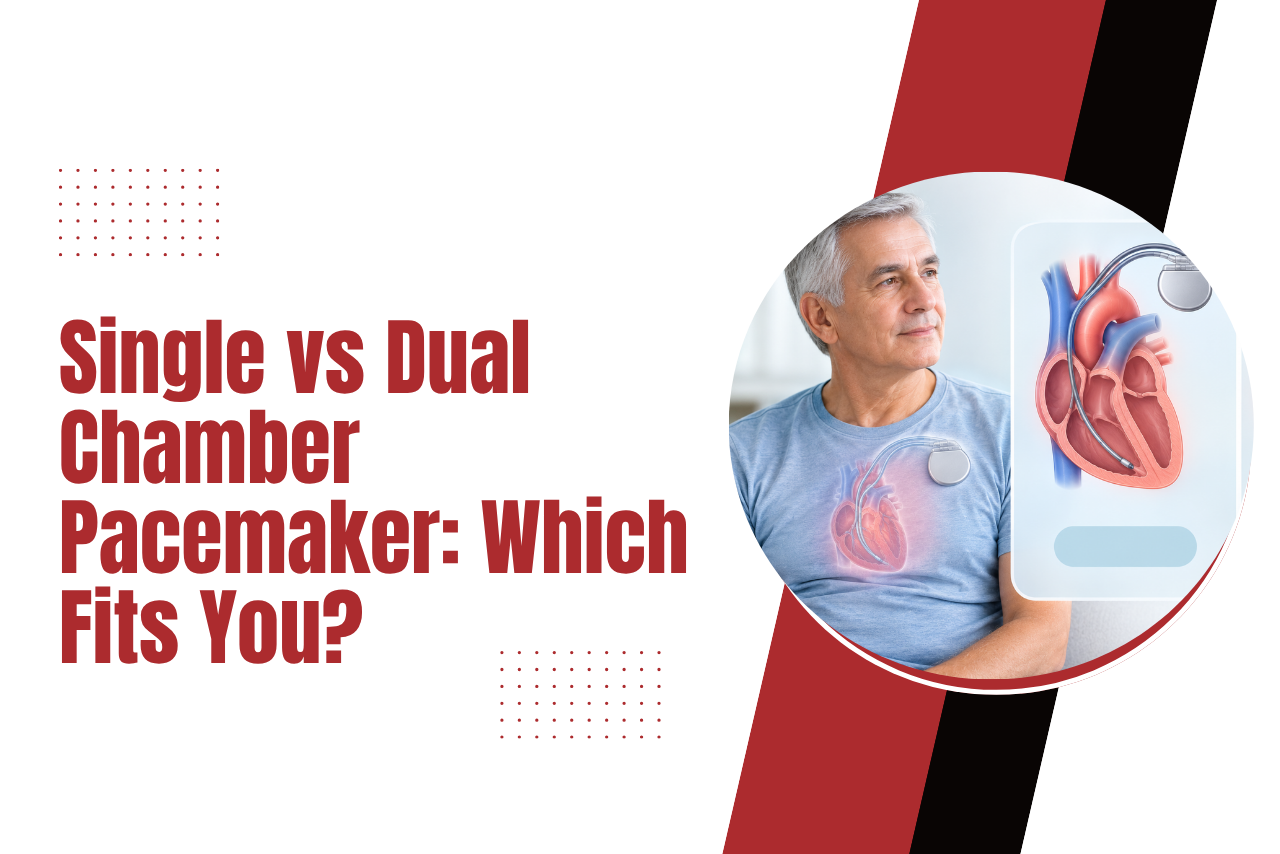
Not every pacemaker does the same job. A single-chamber pacemaker gets by on one wire, pacing just one heart chamber. A dual-chamber pacemaker uses two, running the upper and lower chambers together so they beat in the right order. Sounds like a small difference. It isn’t, really, not once you feel how each one changes daily life. There are a few types of pacemaker out there, and honestly, the single vs dual chamber pacemaker decision usually comes down to one thing: where exactly the heart’s electrical signal is failing.
Dr. Kiran Narang, an experienced interventional cardiologist in Mumbai, says, “Picking between a single and dual chamber device isn’t guesswork.But the right device depends entirely on what the rhythm study actually shows, not a general preference.”
Single-Chamber vs Dual-Chamber Pacemaker: Which Fits You?
Strip away the jargon and the single vs dual chamber pacemaker choice comes down to a short list of real differences.
Feature | Single-Chamber Pacemaker | Dual-Chamber Pacemaker |
Leads used | One | Two |
Chambers paced | One (usually right ventricle) | Two (right atrium and right ventricle) |
Best suited for | Slow rhythm in one chamber, atrium behaving normally | Signal breakdown between upper and lower chambers |
Rhythm coordination | Limited, doesn’t track atrial activity | Closer to a natural heartbeat, keeps both chambers synced |
Common candidates | Isolated ventricular slowing | AV block or sick sinus syndrome |
Funny how two devices doing roughly the same basic job can end up suited to different rhythm problems. If any of this still feels confusing, our piece on pacemaker basics walks through how the device actually works, day to day, once it’s in.
Not sure which type suits your heart rhythm?
What Are the Different Types of Pacemakers?
Pacemakers aren’t one-size-fits-all. What you need depends entirely on which chamber, or chambers, are struggling to keep time.
Single-chamber pacemaker:
One wire, usually sitting in the right ventricle. Does its job quietly when only that one part of the rhythm needs help.
Dual-chamber pacemaker:
Two wires this time, one up in the atrium, one down in the ventricle, keeping both chambers talking to each other the way they’re supposed to.
Leadless pacemaker:
No wires threading through veins at all. Just a small device sitting directly inside the heart, doing its thing with none of the usual hardware.
Biventricular pacemaker:
Saved for specific heart failure cases, where both ventricles need to be paced together or they’ll fall out of step.
None of this gets guessed. It gets measured, tested, and confirmed before anyone commits to a device. Pacemaker Surgery always starts with rhythm monitoring first, never a default pick off a shelf.
Why Choose Dr. Kiran Narang for Pacemaker Implantation in Mumbai?
Dr. Kiran Narang holds an MD, DM, and DNB in Cardiology, all from Topiwala National Medical College and BYL Nair Charitable Hospital in Mumbai. He has over 12 years of experience in cardiology, with hands-on expertise in different types of pacemaker implantation, including single-chamber and leadless devices.
At Hridyarambh Clinic in Marol, Andheri East, that background is exactly why device selection here is a thoroughly thought-out process. It’s based on ECG findings and rhythm monitoring rather than a one-size-fits-all approach.
FAQ’s
Is a dual-chamber pacemaker always better than single-chamber?
Not really, no. Dual-chamber devices earn their keep when both chambers are involved. But if only one chamber needs pacing, a single-chamber device does the job just fine, with less complexity to manage.
How long does a pacemaker last?
Usually around 8–12 years, depending on usage and programming. Routine check-ups keep track of battery life so replacement never comes as a surprise.
Can pacemaker type be changed later?
Yes. If your heart rhythm or medical needs change, the pacemaker system can sometimes be upgraded or replaced with a different type.
Does a dual-chamber device need more maintenance?
Barely more, if at all. Both types need periodic checks. Dual-chamber systems have a few extra settings to review, but it’s nothing dramatic.
References
- NHLBI — How Pacemakers Work — provides details on single- and double-lead pacemakers.
- NHLBI — Before Getting a Pacemaker — covers questions to discuss when choosing a pacemaker.
Disclaimer: This content is for educational purposes only and should not be considered a substitute for professional medical advice, diagnosis, or treatment.